Service
Giving back.
ACM SIGGRAPH
Volunteer since 2001
- Executive Director2026 – present
- Chair and Chair-ElectChair 2025 – 2026 · Chair-Elect 2024 – 2025
- Director, Electronic TheaterSIGGRAPH 2022
- Chair, Business SymposiumSIGGRAPH Asia 2014
- Director, Production CommunitiesSIGGRAPH 2008
- Chair, Computer Animation FestivalSIGGRAPH 2003
- Juror and reviewer: Computer Animation Festival, Sketches, Talks2001 – 2019
Academy of Motion Picture Arts and Sciences
Volunteer since 2004
- Co-Chair, Scientific and Technical Awards Committee2024–25, 2025–26 and 2026–27 seasons
- Co-Chair, Digital Imaging Technology Subcommittee2014 – 2024
- Member, Scientific and Technical Awards Committee2004 – 2024
- Member, Visual Effects Branchsince 2020
Academy Software Foundation
Since its founding in 2018
- Governing Board memberGeneral Member representative · 2018 – present
- Long-time Treasurer
Visual Effects Society
- Member, Technology Committee
- Treasurer, New York SectionElected · 2015 – 2016
A year as SIGGRAPH Chair
I served as Chair of ACM SIGGRAPH from 2025 to 2026, the last of the single-year chairs. We moved to fully public meeting minutes, published the data behind conference site selection, won approval for multi-year chair terms, and formed an Industry Relations Advisory Board, all during a demanding financial year. I wrote a column for the community along the way.
- How do you measure, measure a year?Chair’s Corner · September 2026
- Ensuring our FutureChair’s Corner · July 2026
- Chair’s Corner: April 2026Chair’s Corner · April 2026
- Chair’s Corner: January 2026Chair’s Corner · February 2026
- Rebuilding Trust and Shaping Our FutureChair’s Corner · October 2025
Why I volunteer
The trick is to make industry volunteering part of the job itself. Volunteering is a personal commitment; supporting it is a management one. Four lessons from twenty-five years of it:
When you say yes, fully commit
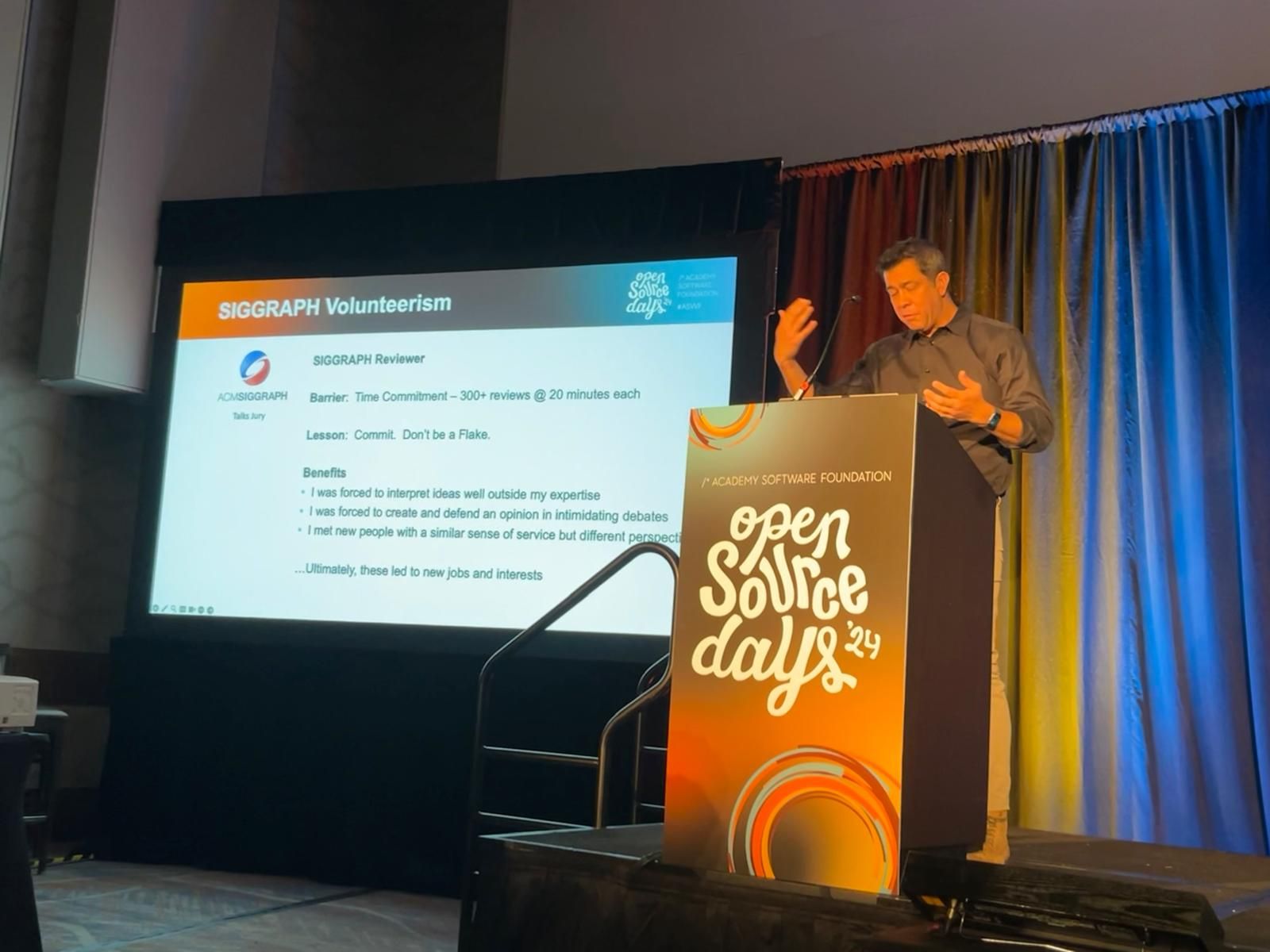
My first volunteer job was reviewing SIGGRAPH Sketches in 2001, because Doug Roble, who sat on the other side of my cubicle wall, put my name forward. I said yes without thinking: over 300 submissions at about 20 minutes each. Doing the whole job, without cutting corners, made me learn areas of graphics I’d never have touched, and then defend my reviews in a room with the authors of my college textbooks. It taught me a self-belief I still rely on.
Speak up, even if you feel like an impostor
Ray Feeney invited me to help investigate the Academy’s Scientific and Technical Awards when I was about 30, probably the youngest participant and one of the few without a Sci-Tech Award of my own. Speaking my mind in front of people who invented computer graphics for film was terrifying. They turned out to be incredibly supportive, and several have advised me ever since, not because they managed me, but because they appreciated the work.
Learn to tell the story
Talking to inventors about their work, then writing recommendations to the Academy, taught me how to explain why something technical matters to the creative arts. That skill made me a better manager, and it matters for anyone who wants their own ideas heard.
Never be afraid to offer
When I moved to New York in 2015 I knew nobody. The Visual Effects Society asked for section officers, I put my name in the hat, and I was elected Treasurer, partly because few others volunteered. The worst that can happen is someone says no. Since then, I’ve found my way into every new city, job and industry the same way.
The value of serial volunteerism
The full story, from my keynote at the Academy Software Foundation’s Open Source Days. It went viral: over 700 views. Serial volunteering isn’t just for engineers; it’s for everyone in this industry. So what are you waiting for?